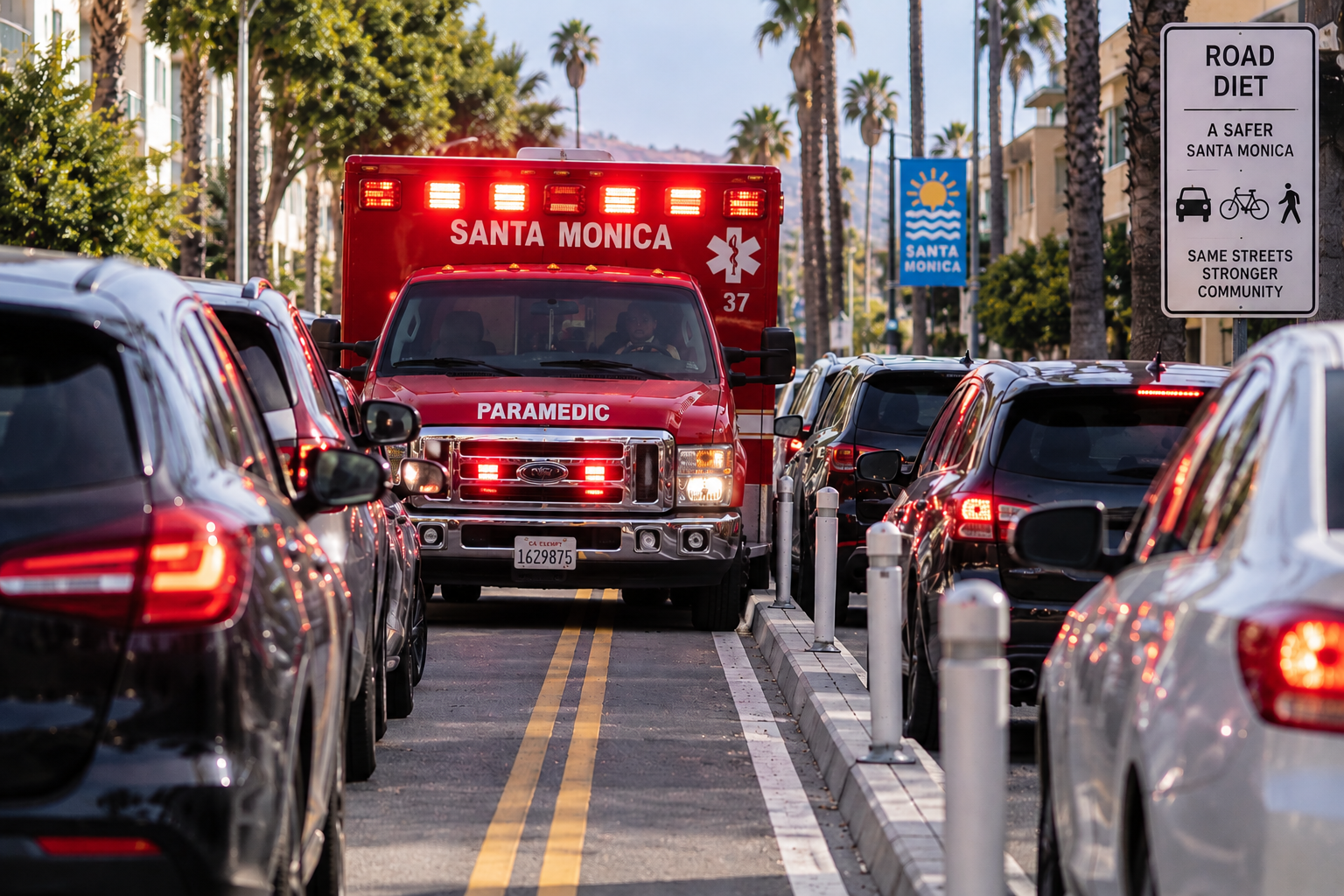
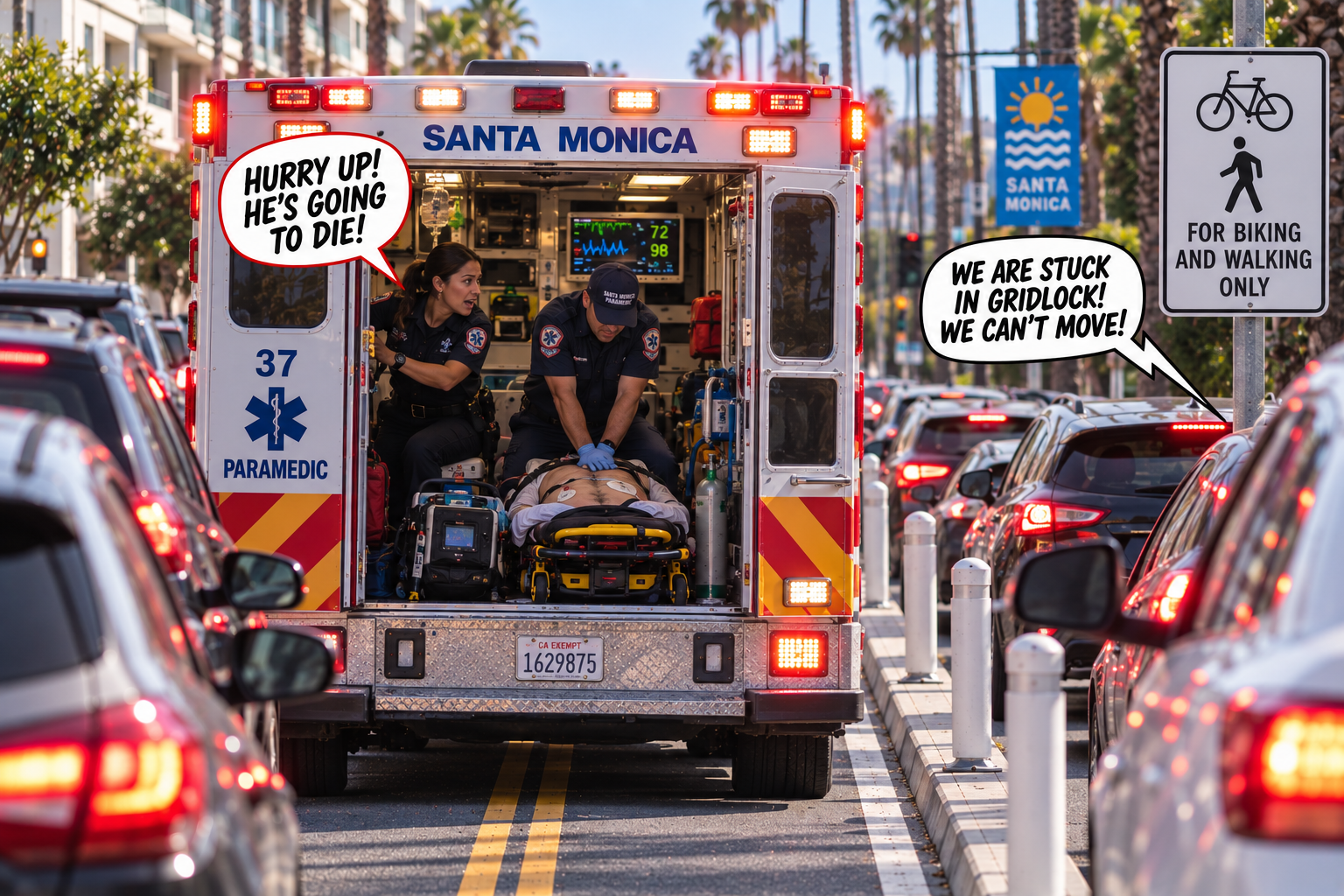
14th Street runs unbroken from the top of the city to the bottom — one of the last continuous north-south connectors left, and a route fire and police units rely on. UCLA Santa Monica Medical Center's emergency department sits one block away on 15th Street. Agenda Item 4.B would award a $1,999,205 contract to squeeze it into a concrete-protected, two-way bikeway — and it's sitting quietly on the consent calendar, meaning it could pass with zero public debate unless residents speak up first.
The staff report for Agenda Item 4.B doesn't ask Council to study whether to narrow 14th Street — it asks Council to award the design contract and authorize the City Manager to sign it, with construction targeted for fall 2028.
Kimley-Horn would be hired for up to $1,999,205 over five years to design a "Two-Way Protected Bikeway" converting the existing painted bike lanes on 14th Street between Pico Boulevard and Washington Avenue into a concrete-separated facility, with raised crossings, signal changes, and new bus/bike mixing zones at transit stops.
Most of the funding — $749,205 — is a state Affordable Housing and Sustainable Communities (AHSC) grant awarded alongside a $49.9 million housing grant to EAH Inc. for the 1318 4th Street development (the former Parking Structure 3). The rest comes from a $1,150,000 Metro subregional grant and $100,000 from the St. John's Hospital development agreement.
The corridor runs past Lincoln Middle School's student pickup/drop-off zone, Memorial Park, Santa Monica College, and crosses Wilshire, Santa Monica Boulevard, and Broadway — three corridors the City's own 2022 Local Roadway Safety Plan already flags as high-collision priority corridors.
Award contract, requires 5 votes for the budget amendment
Concept design, PS&E phase, digital + in-person outreach
After the LA28 Olympics, per the report
Source: City Council Report, Agenda Item 4.B, Sept 8, 2026 meeting
This isn't hypothetical. The City installed concrete-separated bike lanes on 17th Street, and it became one of the most contested infrastructure fights in recent Santa Monica history.
A resident-organized petition against the 17th Street redesign gathered more than 900 signatures, with neighbors describing the corridor as a "concrete obstacle course" after the City installed concrete islands separating car and bike traffic. Santa Monica Daily Press, Dec. 2024 · Santa Monica Observer, April 2023
Neighbors along 17th Street told the Santa Monica Observer and Daily Press the redesign eliminated street parking — including disabled parking spaces — made left and right turns difficult, disoriented drivers unfamiliar with the new lane configuration, and forced bicyclists back into car lanes at driveways and turns, which residents said increased near-miss and collision risk. Then-Councilmember Phil Brock held a site meeting with concerned residents in April 2023 in response.
We don't have City-verified collision statistics for 17th Street specific to this redesign, and we're not going to invent them. What we do have is an extensively documented, still-unresolved resident backlash to the exact design approach now proposed for 14th Street — a much higher-volume connector.
14th Street runs unbroken from north Santa Monica to the south end of the city, past Lincoln Middle School's active drop-off zone and within a few blocks of UCLA Santa Monica Medical Center's Nethercutt Emergency Center (1250 16th Street). A design fight that took years to partially resolve on 17th Street would be happening on a longer, busier corridor that many residents rely on when Lincoln Boulevard and 17th Street are congested.
Concrete-protected, narrowed corridors like the one proposed for 14th Street have drawn direct pushback from the people who have to drive fire engines and ambulances through them.
Los Angeles's firefighters union actively campaigned against a safe-streets ballot measure over exactly this concern. New York's Uniformed Firefighters Association blamed concrete barriers and narrowed lanes for rising emergency response times under that city's Vision Zero redesigns. San Antonio's Professional Firefighters Association publicly opposed a two-way cycle track downtown, warning it would slow fire trucks and ambulances. Streetsblog San Francisco · Streetsblog New York City · News 4 San Antonio
We found no published, corridor-specific emergency-response analysis for the 14th Street project, and no statement from Santa Monica's own firefighters, Local 1109, on this design. That's the point: the City is asking Council to sign a $2 million contract before that analysis exists, on a street that's one of the few continuous connectors left if 17th Street or Lincoln Boulevard is blocked.
The Santa Monica Observer reported this week that the item isn't even scheduled for real discussion — it's bundled into Tuesday's consent calendar, the part of the agenda meant for routine, uncontested business. Unless a resident or councilmember formally pulls it for discussion, it can be approved in a single vote with the rest of the consent items and no debate at all.
Source: Santa Monica Observer, Sept. 7, 2026
Federal accessibility rules for the public right-of-way are specific and non-negotiable. The staff report doesn't show they've been worked through here.
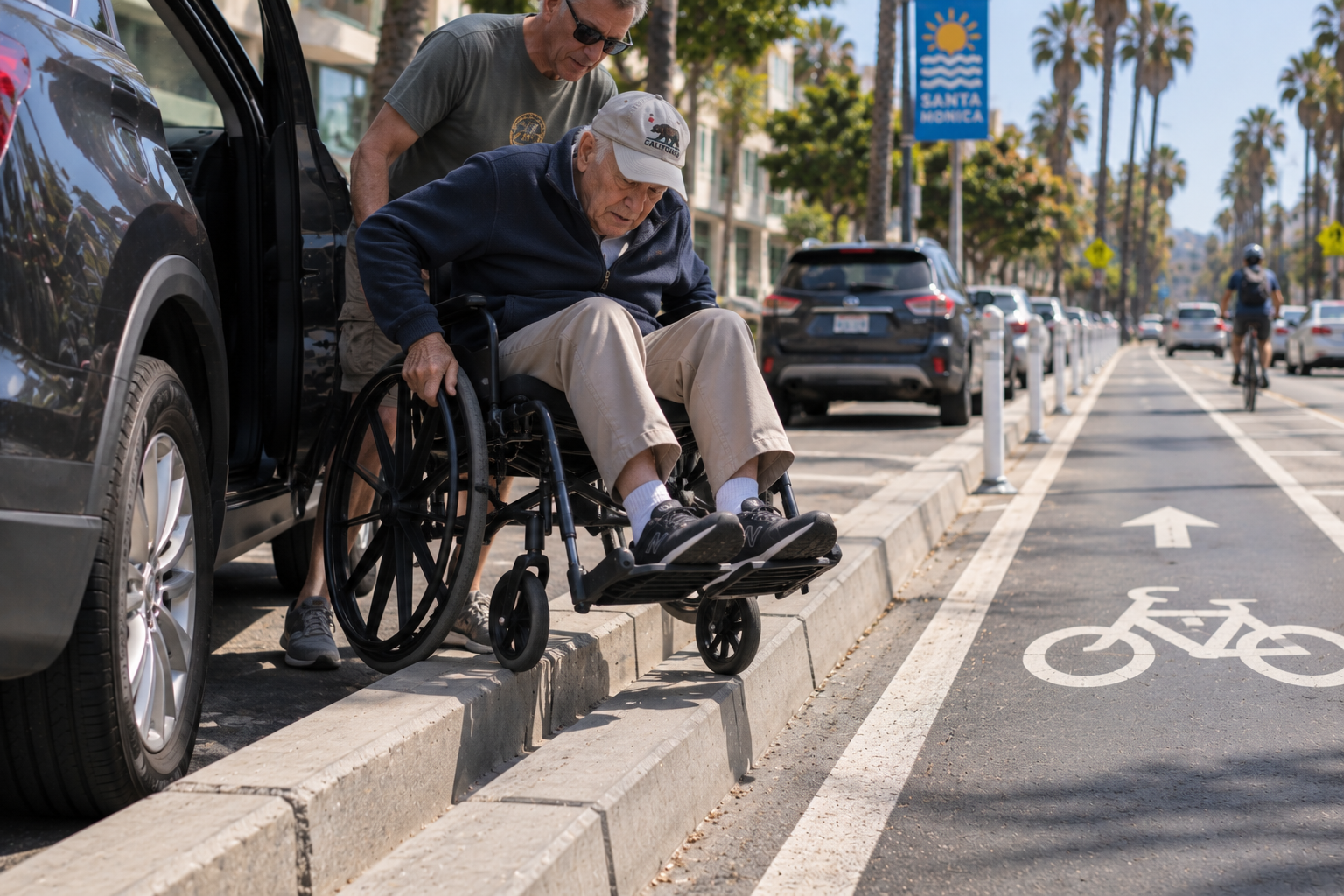
Under the U.S. Access Board's Public Right-of-Way guidance and the 2010 ADA Standards, curb ramps must have a running slope no steeper than 1:12, a minimum clear width, level landings, and detectable warning surfaces — required at every point a pedestrian route crosses a curb that's being altered. DOJ and DOT have jointly confirmed that reconstruction projects like this one trigger the obligation to bring every crossing up to current standard, not just the ones that are convenient.
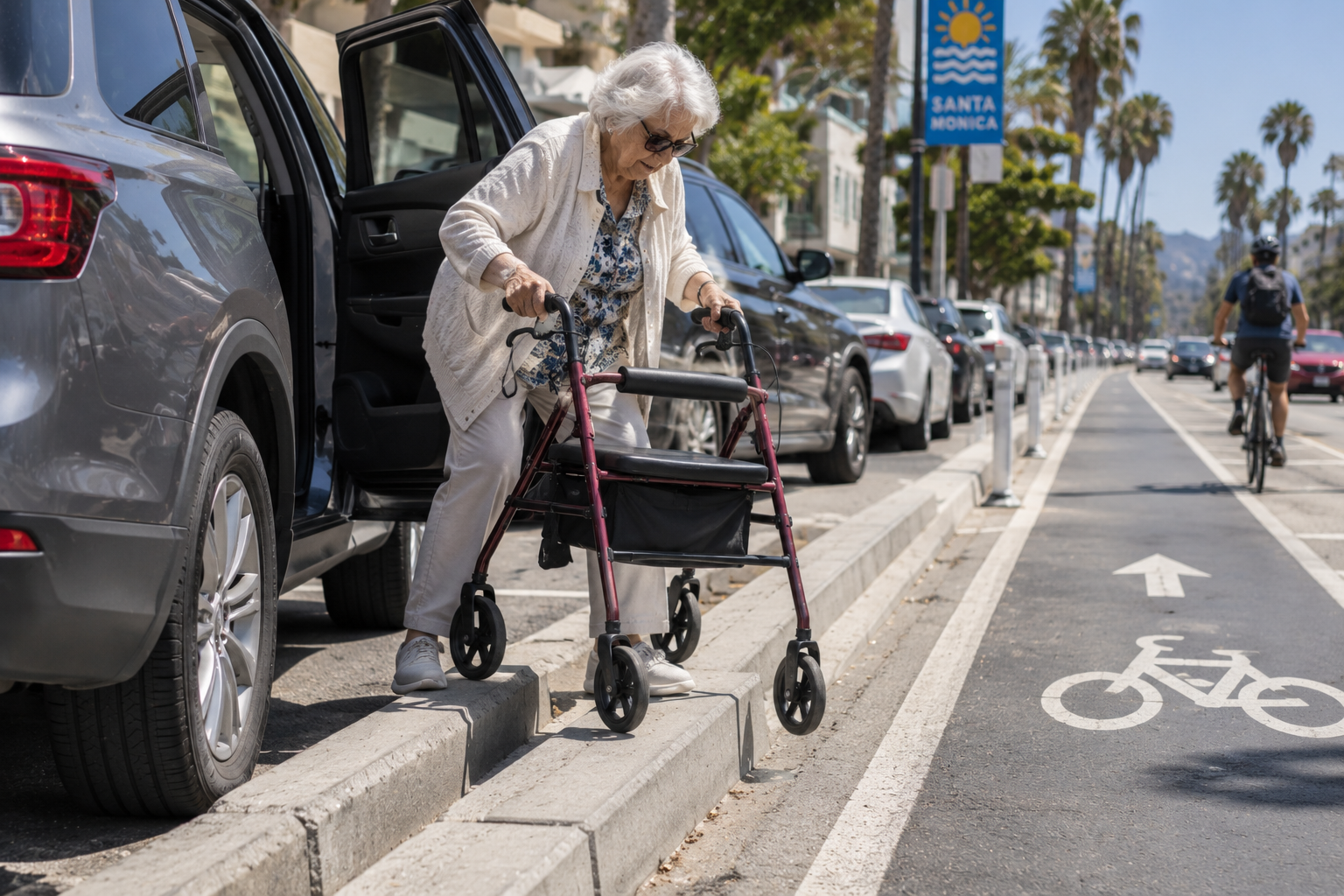
On 17th Street, residents told the Santa Monica Observer the redesign eliminated disabled parking spaces along the corridor. A protected bikeway typically adds a second curb-to-curb transition at crossings — sidewalk to bike lane, bike lane to travel lane — which is exactly where compliance gets harder, not easier. The staff report cites a categorical CEQA exemption. It does not include a published, intersection-by-intersection ADA compliance plan. Residents should demand one before this contract is signed, not after concrete is poured.
"Vision Zero" and "protected bikeway" sound like neutral engineering terms. The advocacy infrastructure behind them is not neutral, and it's not local.
Streets for All, the region's leading "safe streets" advocacy group, is a fiscally-sponsored project of the California YIMBY Education Fund. California YIMBY and its affiliated funds have taken roughly $15 million from Open Philanthropy — the fund run by Facebook co-founder Dustin Moskovitz and Cari Tuna — plus six-figure checks from Stripe co-founders Patrick and John Collison and Yelp CEO Jeremy Stoppelman. This is who is underwriting the advocacy machine pushing this design template statewide.
Sources: The Nation, "An Abundance of Influence" (2026); Housing Is A Human Right (2025, 2026); givelively.org fiscal sponsorship page
In the 2022 Santa Monica election, Streets for All endorsed Caroline Torosis and Jesse Zwick, and endorsed Natalya Zernitskaya again in 2024 when she won her seat. Reporting on the 2024 race found Streets for All contributed $37,500 directly to a PAC backing the same slate. Torosis is now Mayor. This is the same council being asked, on September 8, to award the 14th Street design contract.
Sources: Santa Monica Next, "Streets for All Announces City Council Candidate Forum" (2024) and "Who Is Behind the Big Money PACs in the City Council Race?" (2024)
The bikeway funding is bundled into a state housing grant, not a resident-driven transportation request — and the political infrastructure that put this council in place traces back through Streets for All to the same tech fortunes that fund the YIMBY movement statewide. None of that makes the underlying safety goal illegitimate. It does mean residents are entitled to ask whose priorities are actually being served before a $2 million contract gets signed on a street most of them drive, not bike.
Before residents even get to Streets for All's role in electing this majority, the state's own ethics regulator and the city attorney's office have already been asked to weigh in on this same three members.
In December 2025, the California Fair Political Practices Commission ruled that Councilmember Jesse Zwick must recuse himself entirely from housing- and zoning-related Council decisions because of his paid position with the Housing Action Coalition — barring him not just from voting but from discussion, closed sessions, and even remaining in the room. The City has had to begin ratification proceedings to re-vote multiple housing decisions made while the conflict existed.
Sources: Santa Monica Daily Press, Dec. 2025; Santa Monica Mirror, Jan. 2026
A coalition of neighborhood groups filed a complaint with the city attorney alleging Zernitskaya voted on a major housing agreement after accepting a campaign contribution from an executive tied to the project's service provider — a possible Levine Act violation — that Zwick held undisclosed ex parte communications with the developer's executive director during the hearing, and that Torosis failed to disclose a professional tie to a related agency. The complaint asks the City to void the tainted votes.
Source: Palisades News, Jan. 2026
This is the same three council members — the Mayor and two colleagues — being asked on September 8 to award a $2 million contract funded in part through a housing-linked grant, after the political infrastructure that elected them was substantially funded and endorsed by an advocacy group built on the same tech money that bankrolls the YIMBY movement statewide.
We're not claiming Streets for All's endorsement triggers the same legal disqualification as Zwick's paid HAC job or a direct campaign contribution under the Levine Act — those are specific, documented legal findings, and we're citing them precisely. What we are saying: this council has already shown a documented pattern of unresolved conflicts on infrastructure and housing votes tied to the same advocacy network now pushing this project. Given that pattern, Mayor Torosis, Councilmember Zernitskaya, and Councilmember Zwick should recuse themselves from the 14th Street vote and let colleagues without that funding history decide it — or, at minimum, publicly disclose the full scope of Streets for All's and California YIMBY's support before casting a vote.
"Vision Zero" is marketed as a road-safety program. In practice, on corridor after corridor, it's a template for taking travel lanes and parking away from drivers and handing that space to a small, specific mode of transportation — engineered by an advocacy and funding network built by tech investors, not by the seniors, tradespeople, and parents who actually drive these streets every day.
A protected bikeway is genuinely useful to people who bike the corridor regularly. Nobody disputes that. But the City has published no ridership numbers showing 14th Street is one of those corridors, while it drives daily for seniors getting to medical appointments, working-class residents hauling tools and supplies to job sites, and parents doing school drop-off and pickup. A redesign built for a use case with zero published demand data, at the direct expense of the corridor everyone else already depends on, isn't a safety upgrade — it's a reallocation.
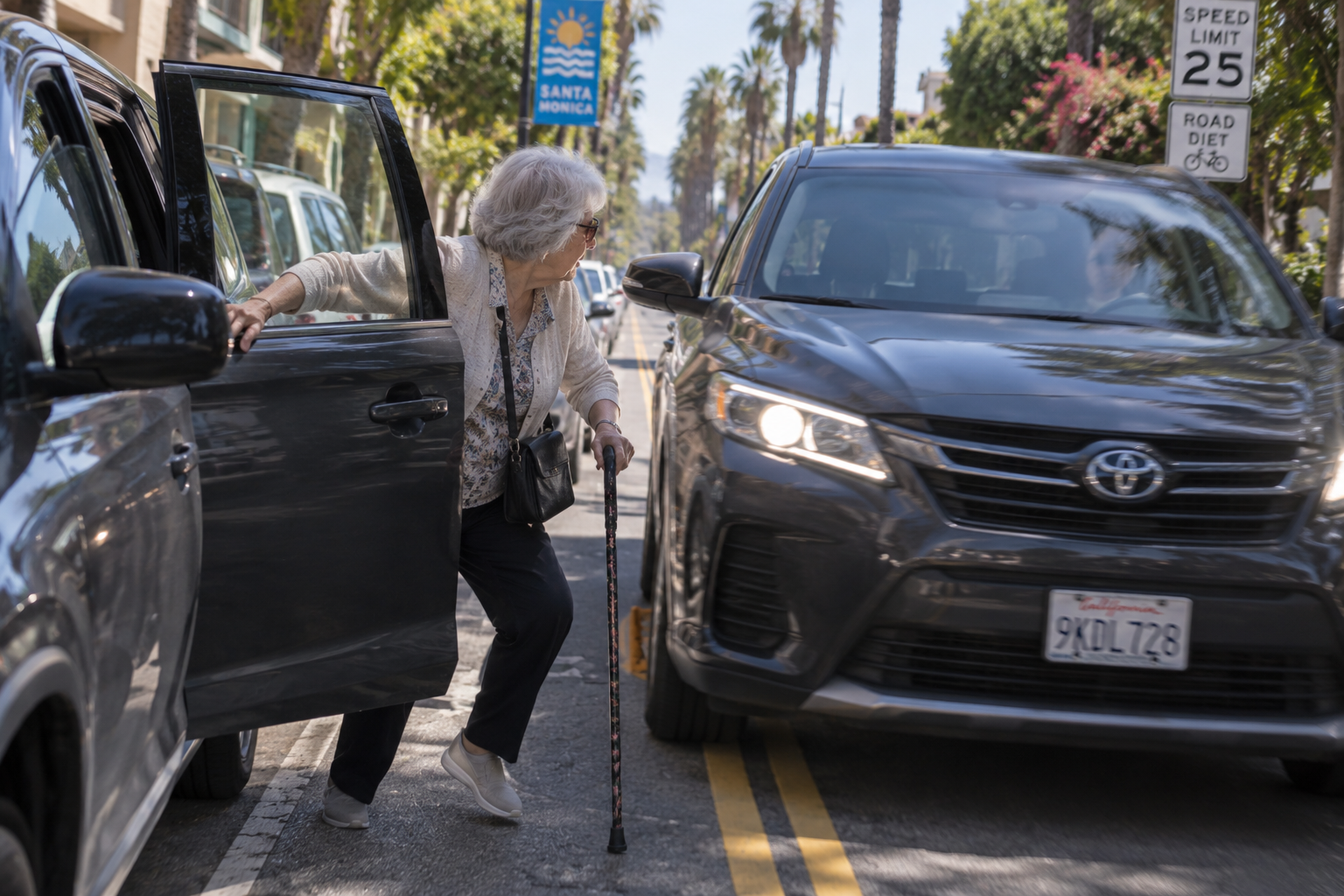
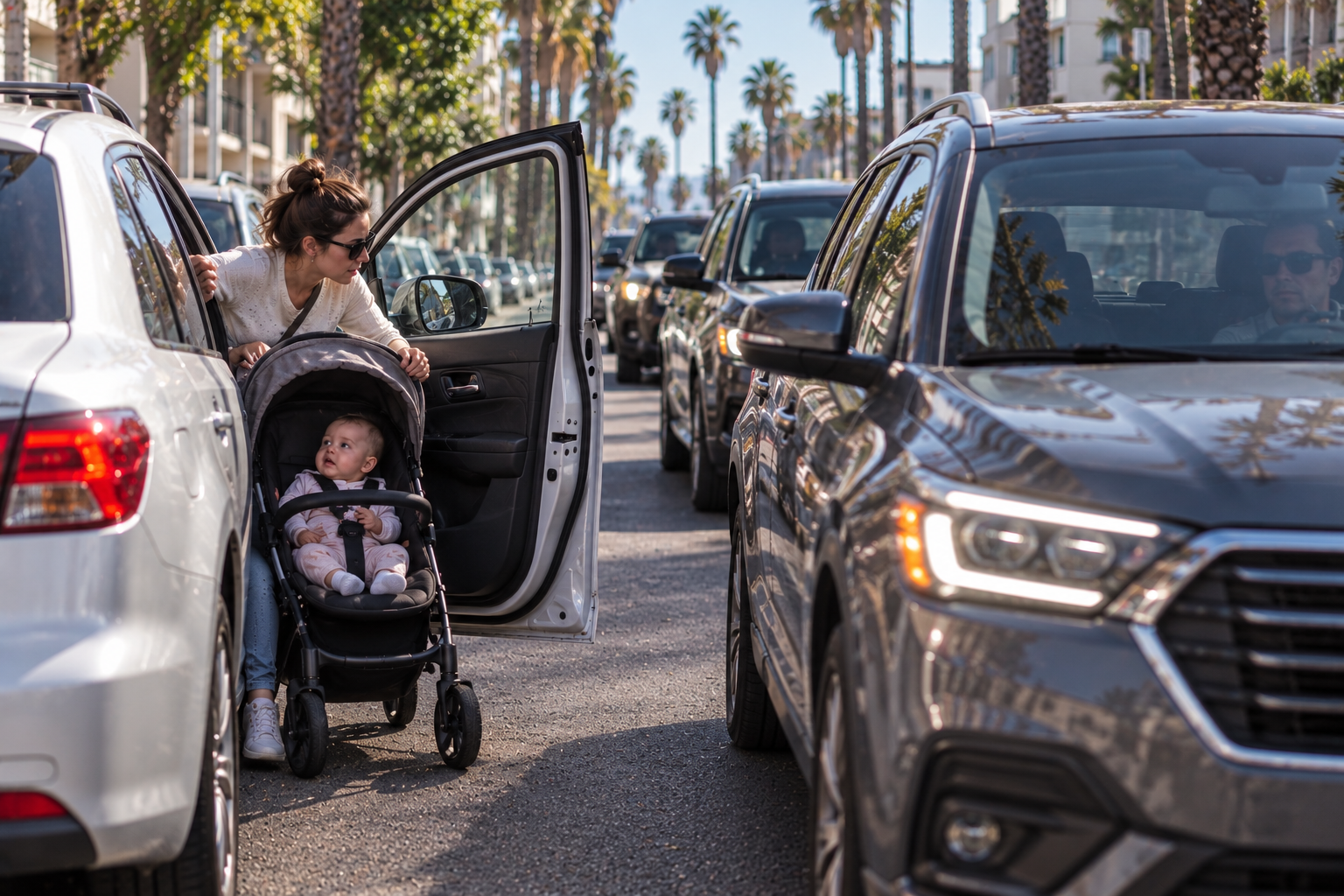
Seniors and people with disabilities generally can't substitute a bike for a car. Tradespeople can't carry tools and equipment on two wheels. Parents with young children, strollers, and car seats can't either. When a corridor is redesigned around bike infrastructure without published usage data to justify it, the people who lose a lane are disproportionately the people who had no alternative to begin with — which is exactly why the ADA and emergency-access questions above aren't side issues. They're the same issue.
None of this means safer streets are a bad goal. It means the specific mechanism being sold as "safety" here was designed, funded, and politically organized by a tech-money advocacy network — documented above — that has its own vision for how people should move through cities. Santa Monica residents didn't design this template and weren't asked whether they want it applied to 14th Street. They're entitled to ask why it's being applied anyway, on a consent calendar, the day after a holiday weekend.
We know the day-after-a-holiday timing makes this hard to keep up with — that's exactly why we built a one-click option below. Every letter sent this way is CC'd to every council member, the city manager, the meeting clerk, and UnsafeStreets@proton.me so we can keep an honest count of how many residents spoke up.
This opens your email app with the letter below, addressed to the full Council, the City Manager, and the meeting clerk, already written and ready to send.
Open my one-click letterIf your email app doesn't open mailto links, or you'd rather send this from your own account: copy the letter, then copy the recipient list, and paste both into a new email.
Whatever happens Tuesday, we're keeping this page live for updates, records, and next steps. If the vote doesn't go tomorrow's way, use the same letter and address list any time to keep the pressure on before construction funding is finalized.